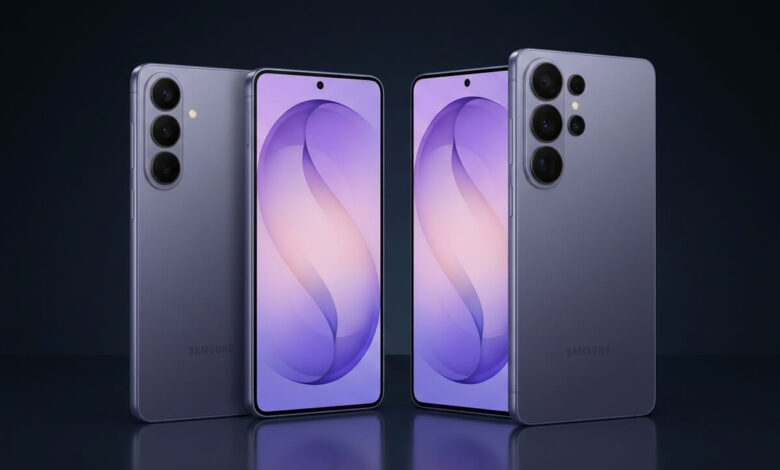
Quick answer: Buy the Galaxy S26+ ($1,099.99) if you want flagship performance, a great screen, and all-day comfort without paying Ultra prices. Buy the Galaxy S26 Ultra ($1,299.99) if you want the best camera Samsung makes, the built-in S Pen, faster charging, and the new Privacy Display. The $200 gap buys you real hardware not just a bigger name but most people will be completely happy with the S26+.
That’s the short version. The longer version matters more, because these two phones are closer than Samsung wants you to think in some areas, and further apart than you’d expect in others. Below, we’ll walk through every meaningful difference camera, display, battery, charging, performance, and the one universal problem both phones share, so you know exactly what you’re paying for before you spend it.
At a Glance: Galaxy S26+ vs Galaxy S26 Ultra
| Spec | Galaxy S26+ | Galaxy S26 Ultra |
|---|---|---|
| Price (256GB) | $1,099.99 | $1,299.99 |
| Display | 6.7″ LTPO AMOLED, 120Hz | 6.9″ LTPO AMOLED, 120Hz, Privacy Display |
| Chipset | Snapdragon 8 Elite Gen 5 (US) / Exynos 2600 (other markets) | Snapdragon 8 Elite Gen 5 (all markets) |
| Main camera | 50MP, f/1.8 | 200MP, f/1.4 |
| Ultrawide | 12MP, fixed focus | 50MP, autofocus |
| Telephoto | 10MP, 3x optical only | 10MP 3x + 50MP 5x periscope |
| Battery | 4,900mAh | 5,000mAh |
| Wired charging | 45W | 60W |
| S Pen | No | Yes, built-in |
| Weight | 190g | 214g |
| Storage options | 256GB / 512GB | 256GB / 512GB / 1TB |
The Real Difference: It’s the Camera, Not the Screen
Most comparisons lead with the display size, but a 0.2-inch difference (6.7″ vs 6.9″) barely registers in daily use. The decision that actually matters is the camera system, and it’s not close.
The S26+ keeps the same triple-camera hardware Samsung has used since the S24+: a 50MP main sensor at f/1.8, a 10MP telephoto capped at 3x optical zoom, and a 12MP ultrawide with no autofocus, meaning close-up shots through that lens come out soft no matter how steady your hands are.
The S26 Ultra’s quad-camera system swaps in a 200MP main sensor at a wider f/1.4 aperture (Samsung says this lets in about 47% more light than last year’s model), a 50MP ultrawide that actually autofocuses, and a second telephoto lens that adds 5x optical zoom on top of the 3x lens both phones share. In practical terms: the Ultra is the only one of the two that can do real macro shots through its ultrawide, and it’s the only one that doesn’t fall apart once you zoom past 3x.
That said, independent lab testing tells a more nuanced story than the spec sheet suggests. At 1x and 2x zoom in daylight, the two phones produce nearly identical results, the resolution gap matters far less than you’d assume when both cameras are well-lit. The Ultra’s real advantage shows up specifically beyond 3x zoom and in low light, where its dedicated 5x lens and larger aperture pull meaningfully ahead.
Display: Bigger Isn’t Always the Win
Both phones use LTPO AMOLED panels at 1440 x 3120 resolution with adaptive 120Hz refresh rates, and both get bright enough to use comfortably outdoors. The Ultra’s screen reaches a higher peak brightness and adds two things the Plus doesn’t have:
- Privacy Display — narrows the viewing angle so the person next to you on a train or in a coffee shop can’t read your screen
- Anti-reflective coating — improves legibility in direct sunlight
These are genuinely useful if you work in public a lot or handle sensitive information on your phone. If you don’t, you likely won’t notice their absence on the Plus.
What you will notice is weight. The Ultra weighs 214g; the Plus weighs 190g. That 24-gram difference doesn’t sound like much until you’ve held a 6.9-inch phone with one hand for a 20-minute commute at that point, the Plus’s lighter, narrower body becomes the more comfortable daily-carry choice for most hand sizes.
Performance: Closer Than the Price Tag Suggests
In the US, both phones run the same Snapdragon 8 Elite Gen 5 for Galaxy chip, so raw performance is nearly identical for American buyers. The catch: in markets outside the US, China, and Japan, the S26+ ships with Samsung’s own Exynos 2600 instead, while the Ultra gets Snapdragon everywhere, no exceptions.
Benchmark testing shows the Snapdragon version pulling ahead of the Exynos one by roughly 7–8% in combined and GPU-heavy tests, but the Exynos chip actually holds up better under sustained, heavy load meaning the Exynos S26+ can be the smarter pick for long gaming sessions, depending on your region. If you’re buying in the US, this entire section is mostly academic, since you’ll get the same chip either way.
Battery and Charging: Where the Ultra Pulls Ahead
Battery capacity is close 4,900mAh on the Plus versus 5,000mAh on the Ultra and real-world screen-on time between the two is nearly a wash. Where the Ultra actually separates itself is charging speed:
| Galaxy S26+ | Galaxy S26 Ultra | |
|---|---|---|
| Wired charging | 45W | 60W |
| 15-min charge | ~38% | ~51% |
| 30-min charge | ~69% | ~84% |
| 0–100% time | ~61 min | ~43 min |
| Wireless (Qi2.2) | 20W | 25W |
If you’re the type of person who charges in 15-minute bursts before heading out the door, the Ultra’s extra speed adds up fast over a week. If you charge overnight and don’t think about it again, this difference won’t change your life.
The S Pen: A Simple Either/Or
The Ultra is the only phone in the S26 lineup with a built-in S Pen, it tucks into the body itself, with no case or separate accessory needed. If you already know you like writing notes, sketching, or signing documents on your phone, this is the single clearest reason to choose the Ultra. If you’ve genuinely never wished your phone had a stylus, you won’t suddenly start missing it on the Plus.
Here’s something most comparisons skip entirely: neither the S26+ nor the S26 Ultra has built-in magnets for true Qi2 MagSafe-style accessories. Both support Qi2.2 wireless charging, but only the base power profile not the magnetic profile. That means magnetic car mounts, wallets, and stands won’t snap into place or align properly on either phone out of the box.
If magnetic accessories matter to you, you’ll need a magnetic case (several third-party options exist specifically to solve this), regardless of which S26 model you buy. This is one of the rare cases where the $200 price gap buys you nothing, it’s a shared limitation across the entire S26 series.
How to Decide: A 3-Question Test
- Do you photograph things up close, at a distance, or in low light regularly? If yes, the Ultra’s 5x telephoto and autofocus ultrawide are worth the premium. If you mostly shoot in good daylight at 1x–2x, the Plus performs nearly identically.
- Have you ever wanted a stylus on your phone? If you already know the answer, you have your answer. The S Pen is Ultra-exclusive, there’s no workaround on the Plus.
- Do you charge in quick bursts throughout the day, or once overnight? Quick-burst chargers benefit meaningfully from the Ultra’s 60W speed. Overnight chargers won’t notice the difference.
If you answered “no” to all three, the Galaxy S26+ gives you the same chip (in the US), nearly the same battery life, a lighter and easier-to-hold body, and a screen most people can’t tell apart from the Ultra’s in daily use for $200 less.
Frequently Asked Questions
Is the Galaxy S26 Ultra worth the extra $200 over the S26+? It depends entirely on whether you use the features unique to it. The camera gap is real beyond 3x zoom and in low light, the S Pen is genuinely useful if you’re a note-taker or sketcher, and the 60W charging is noticeably faster. If none of those apply to your daily habits, the S26+ delivers nearly the same experience for less.
Does the Galaxy S26+ have an S Pen? No. The S Pen is built into the Galaxy S26 Ultra only, and there’s no compatible accessory that adds stylus support to the S26+.
Is the camera really that different between the two phones? Yes and no. At 1x and 2x zoom in daylight, both phones take very similar photos. The real gap opens up at 5x zoom and beyond, and in low light, where the Ultra’s larger sensor, wider aperture, and dedicated 5x lens pull ahead. For everyday daylight photography, most people won’t see a dramatic difference.
Do both phones have the same processor? In the US, yes both run the Snapdragon 8 Elite Gen 5 for Galaxy. In some international markets, the S26+ uses Samsung’s Exynos 2600 instead, while the Ultra always ships with Snapdragon worldwide.
Which phone is better for someone who games a lot? If you’re in a market where the S26+ ships with the Exynos 2600, it actually shows better sustained performance under heavy load than the Snapdragon-powered Ultra in some tests, though the Ultra’s Snapdragon chip wins most synthetic benchmarks outright. In the US, where both phones share the same chip, this is largely a non-factor.
Can I use a MagSafe-style magnetic charger with either phone? Not out of the box. Neither the S26+ nor the S26 Ultra includes the magnetic power profile needed for secure magnetic charging or mounting, despite both supporting Qi2.2. You’ll need a third-party magnetic case to get that functionality on either model.
Is the Galaxy S26+ a downgrade from the Galaxy S25 Ultra? Not exactly, it depends on what you used the S25 Ultra for. The S26+ matches or beats the S25 Ultra in screen brightness and chip performance, but it lacks the S Pen, the second telephoto lens, and the Privacy Display that the S25 Ultra (and now the S26 Ultra) offer. If you relied on those Ultra-specific features, stepping down to the S26+ would feel like a downgrade in those specific areas.
How much heavier is the S26 Ultra than the S26+? The Ultra weighs 214 grams versus 190 grams for the Plus a 24-gram difference that’s noticeable during extended one-handed use, even though the screen size difference (6.9″ vs 6.7″) feels relatively minor.
The Bottom Line
The Galaxy S26+ and Galaxy S26 Ultra aren’t really competing for the same buyer, they’re built for two different relationships with your phone. The S26+ is the smarter buy for most people: same core chip in the US, a body that’s genuinely easier to hold all day, and a camera that performs nearly identically to the Ultra in the conditions most people actually shoot in. The S26 Ultra earns its $200 premium specifically for three things: serious zoom photography beyond 3x, the built-in S Pen, and faster charging and if any one of those matters to how you actually use your phone, the upgrade is worth it. If none of them do, save the $200 and buy the case instead.