OLED MacBook Pro Keeps M5 Chips, So Earlier Tests Show What to Expect
Apple's new OLED MacBook Pro uses the same M5 Pro and M5 Max chips already benchmarked, so speed should match older models while prices rise by $400.
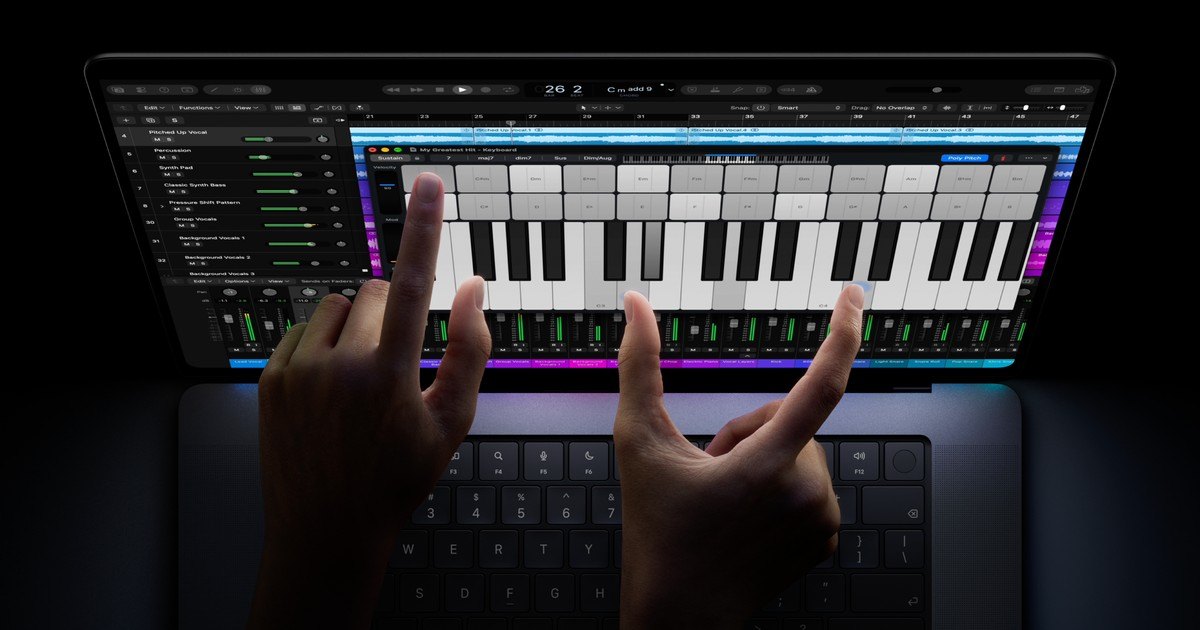
Apple’s new MacBook Pro with a PROLED XDR display uses the M5 Pro and M5 Max chips, the same processors that shipped in the mini-LED MacBook Pros in March 2026. Because those chips were already tested at length, Tom’s Guide says buyers can predict much of the new model’s performance. The short version: expect the same speed, a different screen, and a higher price.
What is new in this model
The change is the display and the body around it. The laptop has a tandem OLED panel (two OLED layers stacked for brightness) in 14.2-inch and 16.3-inch sizes, a 120Hz refresh rate and a rated peak brightness of up to 2,000 nits. It adds a touchscreen with the sensor built into the display and a redesigned hinge, and the camera notch is replaced by a Dynamic Island cutout.
It is also lighter, starting at 3 pounds for the 14-inch and 4 pounds for the 16-inch. Memory goes up to 128GB and storage up to 16TB. Ports match the older model: three Thunderbolt 5 ports, HDMI, an SD card slot, a headphone jack and MagSafe. Pre-orders opened October 28, and the laptop goes on sale November 6.
What earlier benchmarks show
Apple did not move to newer M6 Pro or M6 Max chips; according to Mark Gurman, as reported by Tom’s Guide, Apple is not developing them. The test site’s earlier Geekbench 6 results show single-core scores that are nearly the same across the M5 family: 4,306 for the 16-inch M5 Pro, 4,338 for the M5 Max and 4,288 for the base 14-inch M5. In everyday tasks, then, the Pro and Max models should not feel snappier than a base M5.
Multi-core work is where the gap opens. The M5 Pro scored 28,586 and the M5 Max 29,430, against 22,822 for the M4 Pro, about 25% ahead and roughly in line with the up to 30% Apple promised in March. In the Handbrake video test, the M5 Pro transcoded a 4K clip to 1080p in 1:45, compared with 3:31 for the base M5.
Both chips have the same 18-core CPU. The extra money for the M5 Max buys more graphics cores and more memory. In 3DMark Wild Life Extreme the M5 Pro managed 142 frames per second and the M5 Max 231. Nvidia’s RTX Spark, in a Microsoft Surface Laptop Ultra, beat the M5 Pro in 3DMark Steel Nomad, 2,912 to 2,335, though the M5 Max scored 3,865. In AI tests the picture is mixed: the M5 Pro matched the base M5 in Geekbench AI, and Qualcomm’s Snapdragon X2 Elite Extreme led.
Why it matters for buyers
If you want the most capable laptop, the OLED model does not offer more power. The new models cost $400 more across the board. The 14-inch starts at $2,899 and the 16-inch at $3,399 with the M5 Pro, against $2,499 and $2,999 for the mini-LED versions. M5 Max versions start at $4,499 for the 14-inch and $4,799 for the 16-inch, and a maxed-out 16-inch reaches $14,549.
That extra cost pays for the display, touchscreen and missing notch. Tom’s Guide’s advice is that anyone who only cares about performance should stay with the LCD versions, since the chips are identical.
Battery life is the open question
Apple rates the 16-inch M5 Pro at up to 24 hours, the same as the mini-LED model, despite the lighter body. In Tom’s Guide’s web-surfing test at 150 nits of brightness, the mini-LED 16-inch M5 Pro lasted 21 hours and 25 minutes, and the M5 Max just under 18 hours. OLED panels use less power on dark content but more on bright, white screens, so the OLED result is hard to predict. Apple also says the new models have a completely redesigned thermal system, which could help the chips hold their speed in the thinner chassis.
What to watch next
These numbers come from the earlier models, not the OLED laptops themselves. The site says it will need to run its own battery tests to check the 24-hour claim, and real-world performance could differ slightly because of the lighter body and different screen. Independent reviews should arrive as the laptop reaches customers on November 6.
Source: Tom's Guide